pongbot-official-partner-webtennis24

First AI Tennis Robot

use code WT24 for a 5% discount
First Steps of the Serve Return

First Steps of the Serve Return

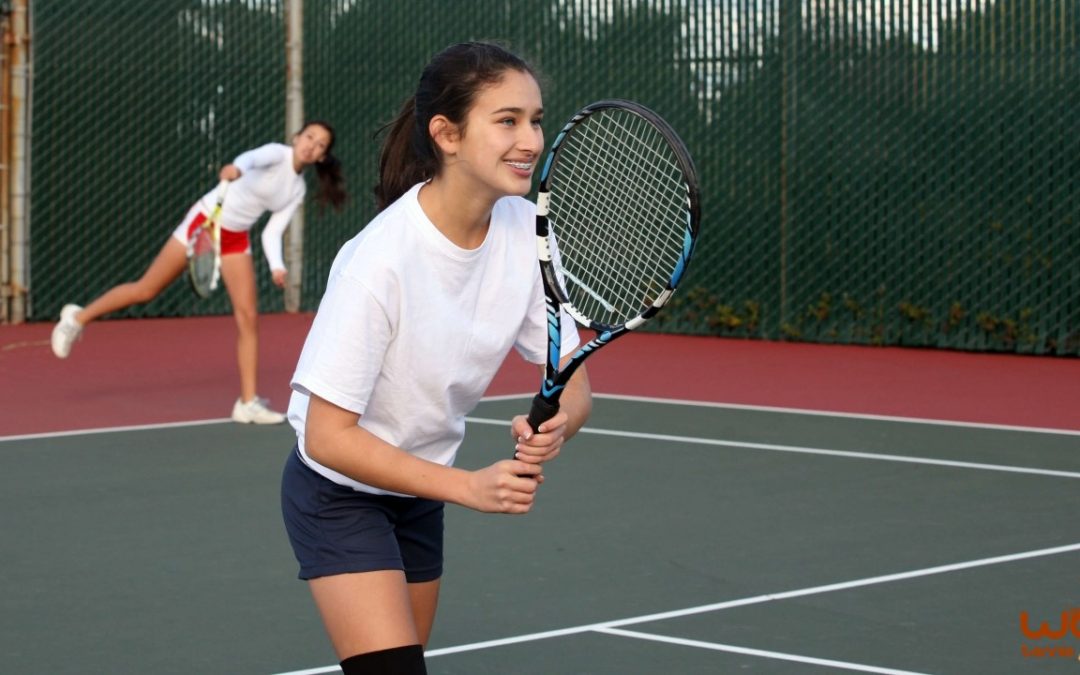
Many variables must go together in putting the ball in play against your opponent’s serve, but in this short article, we’ll only focus on preparation and footwork. If you get these two right, the rest should follow. 

Serve Return Preparation
– Get the most comfortable ready position grip – the one that allows you to switch quickly between forehand and backhand (I am not going to advise you in this regard because you will have to find what grip works best for you).
– Bodyweight should be evenly distributed on the balls of your feet.
– Pay attention to your opponent and try to figure out (based on their toss and racquet path) what kind of serve (spin-wise) they intend to deliver.
– Position yourself in a place that is halfway between your opponent’s possible angles, or open up your strong side to invite the server to deliver toward it (this could be a tricky one and you should be ready to quickly cover it if the serve goes there). 

Serve Return Footwork and Body Balance
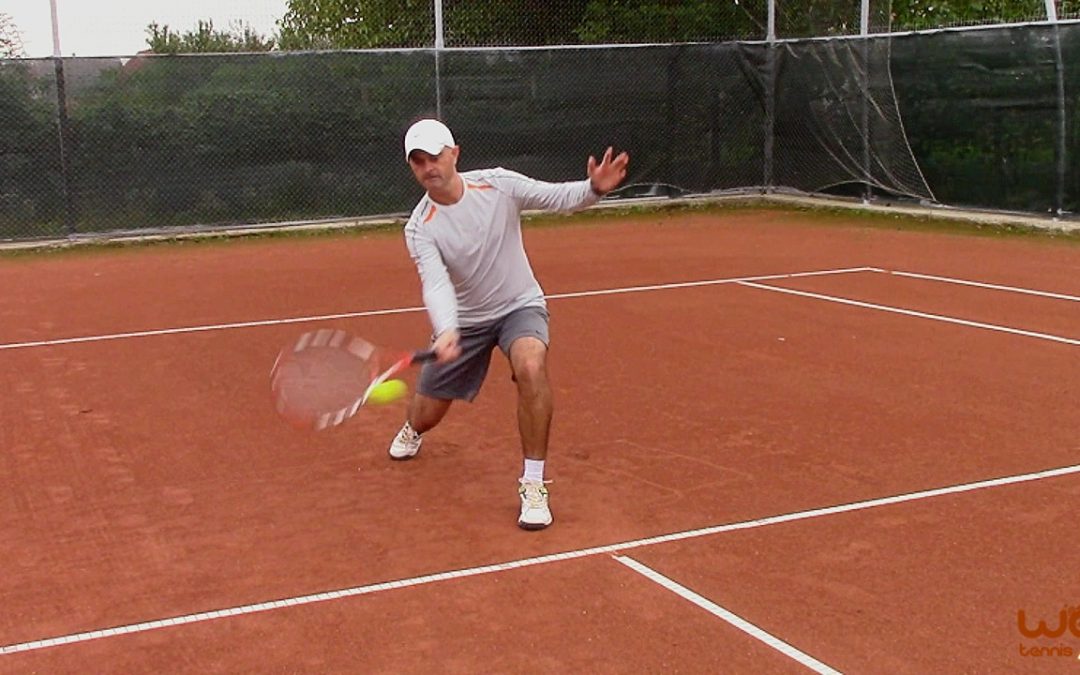
– As the server begins tossing the ball, you should make a “comfortable” step forward followed by a split step.
This initial step-up will get the body moving into the incoming ball and the split step will get you balanced and ready to spring into the direction of the serve.
– Right after the split step, you should load the foot closer to the trajectory of the incoming ball, even stepping into it with the other foot to cover the distance. 

There is so much more (mentally and physically) that goes into a successful return of serve but for now, go out on the tennis court and practice these tips.

Learn tennis techniques with crystal-clear explanations and visual aids. Join Visual Tennis Lessons program and simplify your learning journey!

Cosmin Miholca

Cosmin Miholca

Certified Tennis Coach

Check out my work at WebTennis24 where I share with you my best video tennis lessons, drills and tips for players, coaches and tennis parents.

I’ve Found This to Be the Best Serve Toss Tip

I’ve Found This to Be the Best Serve Toss Tip

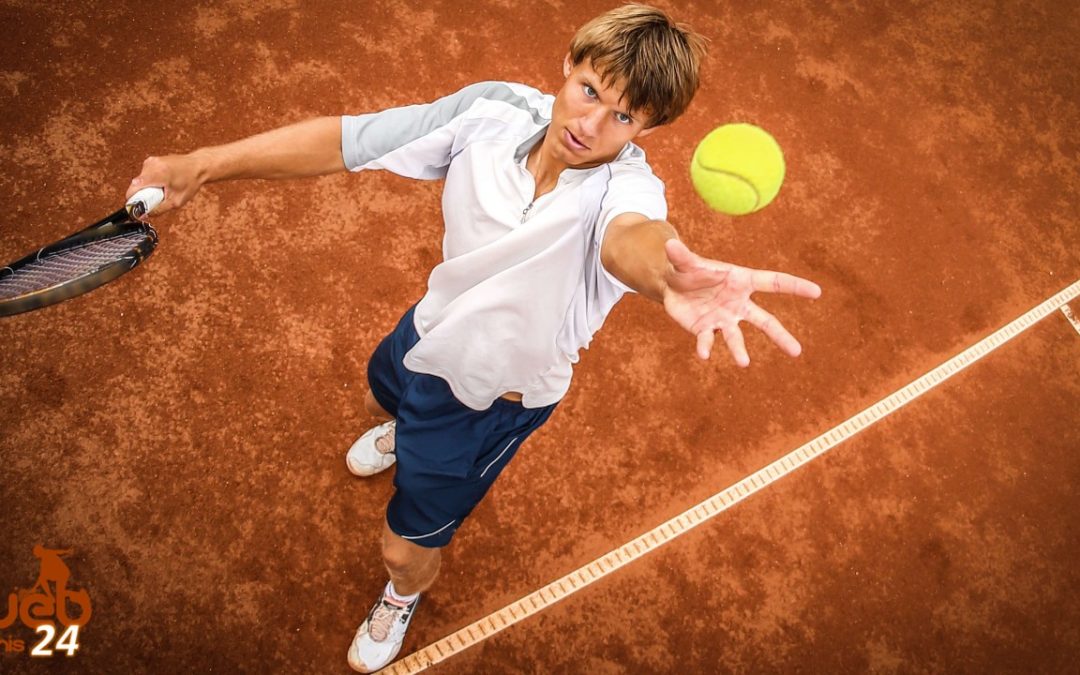
Tossing the ball to serve shouldn’t be hard. I’m not saying that I always do it perfectly but I’ve discovered that one of the easiest ways for a good serve toss is to focus on the outcome: how you want the ball to leave your hand.

Oftentimes, we think about the wrist, fingers, tension in the hand, but we should actually visualize instead what we want to accomplish. 

In the case of the serve toss, my intent is for the ball to go up having… very little rotation on it

This little powerful tip has worked magic for me: the arm relaxes, the grip on the ball is light, and the hand opens so that the fingers do not affect the release of it.

Try it next time you practice your serve or when you’re in a tight match situation – push the ball up with almost no rotation. You might just fix your inconsistent serve toss forever.

Cosmin Miholca

Cosmin Miholca

Certified Tennis Coach

Check out my work at WebTennis24 where I share with you my best video tennis lessons, drills and tips for players, coaches and tennis parents.

Facts You Should Know About Slice and Kick Serves

Facts You Should Know About Slice and Kick Serves

Below I’ve highlighted a few points that will not only give you more spin, but also a better understanding of what it takes to make your serve consistent and harder to return.

But first… why do you need spin on your serve? 

The more rotation your outgoing ball has, the more air pressure is created on top of it that pushes it down. This allows you to swing harder and higher, knowing that the ball will come into the court due to the spin effect.

Your ball’s rotation also makes it more difficult for your opponents to control their return.

Understanding and creating the “slice” effect on your serve:

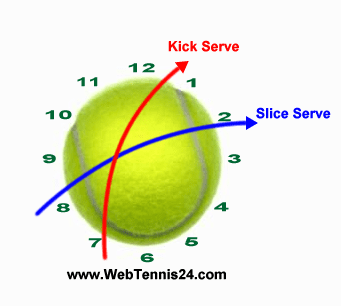
clock face picture of how to hit slice and kick tennis serves– I’ve always pictured the ball as the face of a clock (see graphic). In this case, to impart the slice on your serve, you should swing at the back of the ball from just above 8 o’clock towards under 2 o’clock. That will send your ball spinning more sideways and as a result, it will stay low right after the bounce. 

– To be able to brush for slice, you should toss the ball slightly more towards your dominant side (right if you are right-handed). This should allow you to swing up and away from yourself. 

Understanding and creating the “kick” effect on your serve:

– If the ball would be seen as the face of a clock, to hit a kick serve you should swing from 7 toward 1 o’clock on the back of it. The result will be a ball rotating almost like a wheel as it travels through the air. 

– For brushing the back of the ball in a low to high trajectory, the server must toss it just over the head and slightly above the non-dominant shoulder. 

The toss for the kick serve is higher than the one of a slice serve. It gives the player more time to bend the knees and push up into the ball, which is hit on the downfall. 

Both serves are important to learn for any player:

  • The slice is great for pushing the returner wide (if hit close to the sideline on the deuce side) or jamming the player (make it curve into the body). It is also good for serve-and-volley because the low bounce of the slice serve will prevent the returner from hitting down at the approaching player’s feet.
  • The kick serve can be effective on clay courts, attacking the opponent’s weak wing or pulling the player wide on the ad side (if the server is right-handed – the opposite should be for left-handed players). Some serve-and-volley players use the kick to give them more time to get up to the net, but it should be used with caution because the high bounce of it can allow the returner to hit it back short at approaching the player’s feet. 

Use the picture of a clock when practicing your serves to create great spin effects and make it more difficult for your opponents to return your serves.

Cosmin Miholca

Cosmin Miholca

Certified Tennis Coach

Check out my work at WebTennis24 where I share with you my best video tennis lessons, drills and tips for players, coaches and tennis parents.

How to Avoid Choking… When Serving

How to Avoid Choking… When Serving

One of my fellow coaches recently shared a story with me.

He told me how he is teaching a young man, whose serve is great during his lessons when there is no receiver at the other end. During the tennis matches though, when there is the pressure of having somebody return the serve, his student often chokes (misses a lot).
He wanted to know what he could do to help him…

My advice (which I’m hoping you will find useful too) was the following:

  • His student is probably too concerned with what the opponent’s reply will be. He’s anxious about the return and therefore he cannot relax when serving. Therefore, he must be taught to focus (when serving) on things like breathing, spin, and visualization (seeing the ball go to a certain spot inside the service box, etc.) – this would help him take his mind off of his opponent.
  • He should also have somebody return his serve (e.g. his coach, or practice partner) most of the time he practices it. Of course, his coach will have to stay next to him and correct the serve technique most of the time, but they should change it up sometimes. For example, the student can hit 20 serves with the coach next to him, then 20 serves with the coach returning the serves – in that case, the student should be doing it until the coach/practice partner returns 20 balls; and so on. My overall point is that every time someone works on their serve, they should do some pressure practice of it too.

Set and achieve your tennis goals with our comprehensive training. Join Ultimate Training for Tennis Players and unlock your success!

Cosmin Miholca

Cosmin Miholca

Certified Tennis Coach

Check out my work at WebTennis24 where I share with you my best video tennis lessons, drills and tips for players, coaches and tennis parents.

What Options Do You Have When Your Opponent Attacks at the Net

What Options Do You Have When Your Opponent Attacks at the Net

One of my students recently asked me:
“What are my options when my opponent attacks at the net?”

The answer is not an easy one because it depends on many variables that must be taken into consideration:
– your position on the court
– are you on the run, stretching to the ball, or in balance?
– is the ball coming to your stronger or weaker side?

As general rules, aside from the before-mentioned situations, you should remember the following:

1. Try to pass with a topspin cross-court shot aimed at the corner of the service line.
The topspin and shallow trajectory of the ball will make it difficult for the net player to pick it up.

2. A lob is always very effective if executed properly: over the attacker’s weak side (e.g. backhand) or deep cross-court.

3. The down-the-line shot can pass the net player a lot quicker, but it could be risky because of the higher net, less margin for an error, and, besides, if your opponent gets the racquet behind the ball, they’ll have a nice opening for a cross-court put-away.

In my opinion, to keep things simple, I’d try to stick with the first two options as my overall tactics when my opponent attacks at the net.
You should though vary and surprise your opponent with a different tactic once in a while to keep them from finding you predictable.

Cosmin Miholca

Cosmin Miholca

Certified Tennis Coach

Check out my work at WebTennis24 where I share with you my best video tennis lessons, drills and tips for players, coaches and tennis parents.

What It Takes to Win in Tennis

What It Takes to Win in Tennis

I just finished watching an excellent movie, “Ender’s Game”… It made me “jump” on my keyboard and write these thoughts:

Tennis is a sport that gives us pleasure in two ways: through competition, or… the feeling of working out/hitting the ball.

If you are in this sport to compete, then… you need to learn how to win!

Many tennis coaches and players spend hundreds of hours perfecting their stroke techniques. While that is very important, I do not think it should be over-emphasized.

For me, the priorities in tennis are:
1. technique
2. movement
3. tactics/strategies

In the movie I mentioned above, there is a character who is not the best fighter or the smartest among his peers – he is just the best at understanding how to defeat his enemies. He knows what it takes to win and he makes sure to get it done.

Tennis players often spend too much time perfecting their technique. It should be done according to the tactics that one has to apply against certain opponents.

That’s because, for example, the forehand is not always the same when hit from different parts of the court or in rally situations (stretched, close to the net, defending from behind the baseline, off-balance, etc.).

It is more important that you study the court geometry, and stroke options (placement and spin), AND begin to pay attention to your opponents’ weaknesses from the beginning of any match.

Those are the skills that will allow you to enjoy the sport even more and win more tennis matches.

I’ve spent a great deal of time providing you with my best knowledge in the area of winning in tennis so you too can understand and enjoy it at a higher level.

Whether you play singles or doubles, there is a wealth of information on how to beat the pushers, the serve-and-volley players, how to deal with the wind (in singles) or how to win using the one-up-one-back formation, how to position yourself on the court for the best results, how to use the I-formation (in doubles) and so much more.

Also, learn the court geometry (positioning so that you use less effort and get the best out of your shots) and stroke tactics (how, where, and why you should place your serve, ground strokes, volleys, etc.).

Ready to take your tennis game to new heights? Join Ultimate Training for Tennis Players and unlock your potential!


Cosmin Miholca

Cosmin Miholca

Certified Tennis Coach

Check out my work at WebTennis24 where I share with you my best video tennis lessons, drills and tips for players, coaches and tennis parents.

What Is the Best Doubles Formation in Tennis

What Is the Best Doubles Formation in Tennis

Recently, I was asked to express my opinion about which doubles formation is the best to least and why: the two players at the net (both up), two players at the baseline (both back) or one at the net and the other at the baseline (one-up-one-back)?

While one of them is quite obvious to be the better of all three (in general), the other two are up for a debate….

Before I get into the details, I want to point out that my analysis is made as a general guide and that’s because when you assess one team’s best tactics and strategies you must consider each player’s technical skills, experience and the team’s capability to work and communicate together. 

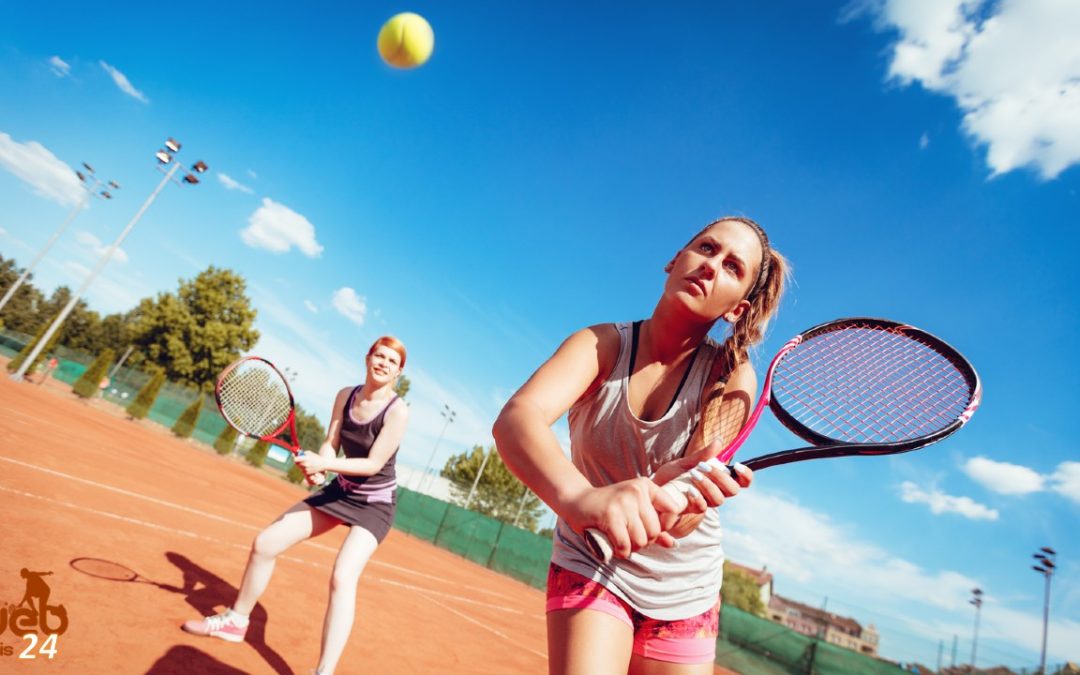
Having said that, I am a strong believer that the best formation would be the… both-up.

If the two players manage to get to the net, they will be in the best position to put pressure on their opponents, cover the court, and finish the points in the quickest ways possible.

When two players are at the net and assuming they cover the court properly, the only way for them to be passed by their opponents is through the backcourt – lobs.

The both-up formation has the following advantages:

1. Puts pressure on the opposing team (defending) – the ball comes back sooner; they must watch for angle shots.

2. They can cover a lot more court and there is almost no opening for the opponents to pass (except when using the lob which, if not executed properly, can be an easy smash opportunity). 

3. The ability to put the balls away (finish points) is greater at the net due to the many angle opportunities and the fact that you can take the ball above the net level.

Now, the question of whether playing the one-up-one-back versus both-back formations is more a matter of players’ style (technique, experience, and capability to feel comfortable playing at the net or not):

The one-up-one-back formation is mostly played by players who are new to the doubles game. But some of the more advanced players apply it too sometimes…

Situations the one-up-one-back formation is being applied:

1. When the serving/receiving player is not comfortable moving up (transitioning and playing at the net).

2. When the serving/receiving player is stronger from the baseline.

Disadvantages of playing the one-up-one-back formation:

1. The player staying back opens up the court for short angles on their side; also, it takes longer for their shot to go back over the net, giving the opposing net player time to intercept it. 

2. The gap between the two players (baseline and net) is wide enough for the opposing net player to have a winning shot.

3. The baseline player has fewer options for their shots to be aggressive – they must avoid the opposing net player and the only time they can attack is when the ball is shorter in their court.

In the case of both players staying back, there are strong reasons why some teams can do it:

1. Both players are not comfortable playing at the net, but they have reliable groundstrokes. 

2. The team is receiving against a strong server – it is wise to begin the point with both players on the baseline and advance after the return is safely made. 

3. The team’s serves are being aggressively attacked by the opposing team (ex. If the serve is not powerful or deep enough and the returner attacks the net player, it is a good idea for the server’s partner to begin the point further back, close to the baseline).

Disadvantages of playing both-back formation:

1. There are many angle openings for the opposing team to put the ball away. 

2. Hard to cover the forecourt (against drop-shots or short angles etc..)

3. Difficulty in finishing the points – they hope the opposing team makes mistakes.

As a review, any committed doubles player should strive to improve the net skills (volleys and overheads), and most importantly transition to the net, which for the most part can set you up for a comfortable play at the net if executed properly.

In the end, there is not one formation that works for everyone – it is the one that suits your style of play and your personality.

Ready to take your tennis game to new heights? Join Ultimate Training for Tennis Players and unlock your potential!
Cosmin Miholca

Cosmin Miholca

Certified Tennis Coach

Check out my work at WebTennis24 where I share with you my best video tennis lessons, drills and tips for players, coaches and tennis parents.