pongbot-official-partner-webtennis24

First AI Tennis Robot

use code WT24 for a 5% discount
Do NOT Copy the Pros!!

Do NOT Copy the Pros!!

It was 2003… the year I earned my tennis teaching certificate.

Despite my playing experience and theoretical understanding of teaching tennis, there were still so many gaps in my knowledge about how to actually coach people.

My students were all unique individuals – each with their strengths, weaknesses, and personalities.

As a young coach, it took me a while to learn that I had to adapt to every single student I encountered.

Once I became a certified tennis coach, I assumed that the methodology I learned from this esteemed tennis teaching organization would provide me with a “one-size-fits-all” formula that would suit every student who entered my tennis court.

I was wrong!!

Only when I learned that people are unique and they each had to be approached according to their personality, did I begin improving as a tennis coach.

Tennis is not a one-size-fits-all sport.

You were born with certain personality traits which are reflected in the way you strike the ball, the way you move, and the way you make decisions on the court.

skilled coach can help you discover the basics of how to play tennis in a way that complements your own unique playing style.

Don’t try to be like the pros!

Be yourself and play tennis in your own way…

The way that feels right to you.

Master tennis technique with ease through our expertly designed drills. Join Visual Tennis Lessons program and experience effortless learning!

Cosmin Miholca

Cosmin Miholca

Certified Tennis Coach

Check out my work at WebTennis24 where I share with you my best video tennis lessons, drills and tips for players, coaches and tennis parents.

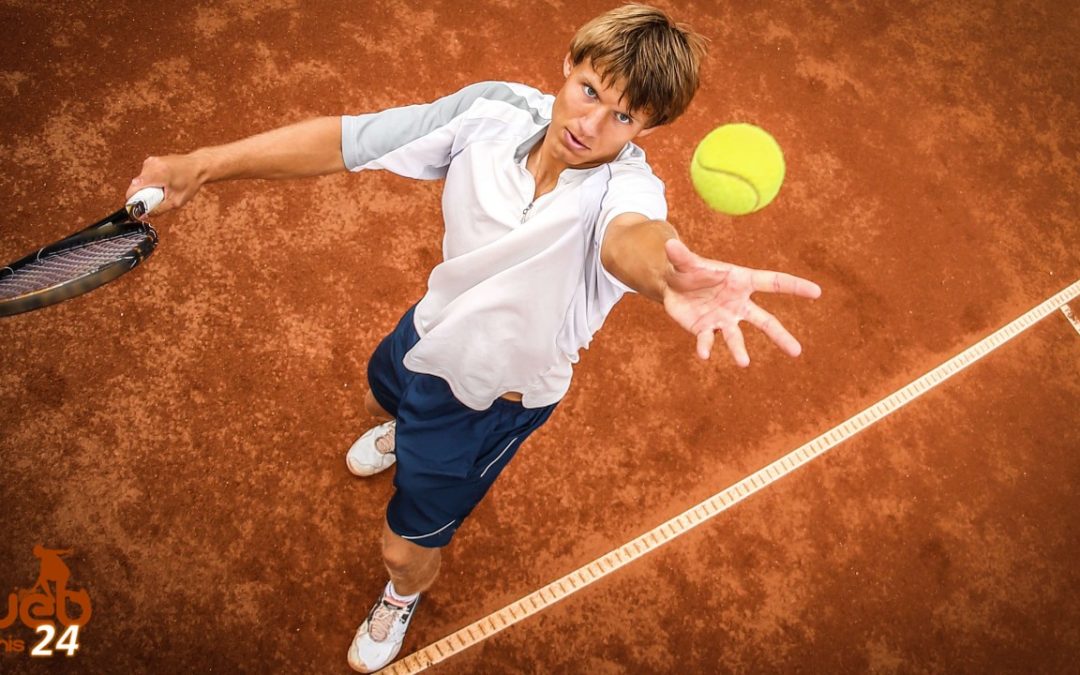
Serve Problem. Here’s How I Fixed It…

Serve Problem. Here’s How I Fixed It…

Here’s how I fixed the serve problem of one of my students.

This particular lady used to take lessons with me a couple of years ago.
She called me on a Wednesday afternoon saying that she was lacking consistency and did not know what was the problem with her serve.

We met the next morning after my usual 8:30-9:30 am class, and after she warmed up, I made a few steps away and looked at her while she was delivering most of her serves long, just a foot beyond the service line. Over and over…

I soon noticed the problem:
She was releasing the ball very early and then lowering the tossing arm right away.
This caused a loss in balance and low contact with the ball.

So here’s what I did to fix her serve consistency within a few minutes…

I asked her to continue serving focusing on one thing only: keeping the tossing arm up and extended towards the sky after releasing the ball until she sees it coming down.
She got her balance back and made contact a lot higher.
The result: more power and… more serves landing inside the service box.

There are a few technical elements that players need to be aware of in order to deliver the serve with consistency and power. These elements can make a big difference in someone’s game.

If you are a tennis coach or a parent of a child who wants to learn how to play tennis, you should definitely check out the My Daddy / My Coach and the 10 Lesson Plans / How to Teach Tennis program.

Cosmin Miholca

Cosmin Miholca

Certified Tennis Coach

Check out my work at WebTennis24 where I share with you my best video tennis lessons, drills and tips for players, coaches and tennis parents.
How to Hit More Serves In… Under Pressure

How to Hit More Serves In… Under Pressure

I’ve always considered that a high percentage who serve deliverability, especially under pressure, depends on… the player’s mental strength.

As a player prepares to hit the second serve, thoughts of “I’m going to hit it into the net”, “My opponent will attack me” or “I’m going to miss it” often distract and impede them from hitting it with confidence.

You see, when a player gets ready for the first serve, there is very little pressure involved other than the desire to go for a winner or place it strategically (e.g. to the opponent’s weak side).

But when the second serve is about to be delivered, that’s when our thoughts begin to challenge us.

One must understand that the serve is very sensitive to negative thinking: your racquet “becomes” heavy, the arm too tense, the whole body gets shaky…

To avoid these feelings before you are about to serve (second serves in particular) practice the following:

  1. Think positive thoughts (“I know I can”, “I have confidence”, “I can do this”).
  2. Visualize positive outcomes (“see” the ball going over the net and inside the desired service box).
  3. Have a ritual (bounce the ball a certain number of times, etc.).
  4. Relax your body (exhale slowly).
  5. Take your time… Position your feet, adjust the grip, and hold the racquet in your most comfortable way. Take one more look toward your opponent’s position and at the service box you are about to send the ball to.

“If you believe you can, you might. If you know you can, you will.” ― Steve Maraboli

Ready to take your tennis game to new heights? Join Ultimate Training for Tennis Players and unlock your potential!


Cosmin Miholca

Cosmin Miholca

Certified Tennis Coach

Check out my work at WebTennis24 where I share with you my best video tennis lessons, drills and tips for players, coaches and tennis parents.

Easiest Way to Win in Doubles

Easiest Way to Win in Doubles

When I was asked to express my opinion about which doubles formation is the best and which is the least effective at winning points quickly, I did not hesitate with my answer: both players at the net (both up) would be my favorite, while the two players at the baseline (both back) to be the defensive one and taking longer to finish/win points.

Here is my argument about why you should consider playing at the net more often:

But before I get into the details I want to point out that my analysis is done as a general guide and, when assessing one team’s best tactics and strategies, we should consider each player’s technical skills, experience, and their capability to work and communicate as a team.

I believe that the best doubles formation is… both-up.

When the two players manage to get to the net, they will be in the best position to put pressure on their opponents, cover the court and finish the points in the quickest way possible.

When the team is at the net, the best chance for the opponents to pass them is using the backcourt by sending the ball over their heads (lobs).

The both-up formation has the following advantages:

  1. It puts pressure on the opposing team (which is defending), giving them less time to prepare for the shot.
  2. They can cover a lot more court and there is almost no opening for the opponents to pass (except when using the lob which, if not executed properly, can be a “smash” opportunity).
  3. The ability to put the balls away (finish points) is greater at the net due to the many angle opportunities and the fact that they can contact the ball above net level.

But let’s not rule out the reasons why some players or teams prefer to play from the baseline, in doubles…

The case for both players staying back can be understood considering the following aspects:

  • Both players are not comfortable playing at the net but they possess reliable ground-strokes.
  • The team is receiving against a strong server – in this case, it is wise to begin the point with both players on the baseline and advance after the return is safely made.
  • The team’s serves are being aggressively attacked by the opposing team (example: if the serve is not powerful or deep enough, the returner attacks the net player; in such situation, it is a good idea for the server’s partner to begin the point further back, close to the baseline).

Disadvantages of playing both-back formation:

  1. Many angle openings for the opposing team to put the ball away.
  2. Hard to cover the forecourt (against drop-shots or short angles etc.).
  3. Difficulty in finishing the points – they wait for the opposing team to make mistakes.

Any committed doubles player should strive to improve the net skills (volleys and overheads) and most importantly transitioning to the net which for most part can set them up for a comfortable play at the net if executed properly.

For more detailed analysis of how to play and win in doubles, sign up for the Training membership to learn how to play against different doubles formations, how to communicate with your doubles partner, how to cover the court and get to the ball quicker – watch easy to follow graphics and detailed information for beginning and advanced players.

Transform your tennis game and achieve your goals with Ultimate Training for Tennis Players!

Cosmin Miholca

Cosmin Miholca

Certified Tennis Coach

Check out my work at WebTennis24 where I share with you my best video tennis lessons, drills and tips for players, coaches and tennis parents.

Aggressive Doubles Strategy: The Lob

Aggressive Doubles Strategy: The Lob

Many recreational tennis players think that the lob is a “cheap” shot and its main purpose is to “annoy” the opponents. But the best players know that it can be used as an aggressive tactic to take over the net and set themselves up for a winner. Here’s how:

doubles tennis strategyAs you see in the attached diagram, lobbing the net player can greatly affect the defending team (the one being lobbed: BP-NP) which has to change positions to retrieve the lob:

The net player (NP) must switch sides and back up (anticipating an eventual overhead from the opposing team);
The baseline player (BP) has to also switch sides to return the lob.
Both players from the defending team will be on the run to play the next ball, which makes it difficult to continue the point.

On the other side, the attacking team (OBP – opposing baseline player, and ONP – opposing net player) following the lob will take position at the net with a high chance to finish the point with an overhead or a high volley.

Important:
For a lob to be considered an aggressive shot, it should have lots of topspin (to begin with) and be placed deep, well beyond the service line.

Use the lob to give your team time to move up to the net and make your opponents play defensive.

For more doubles-winning tactics, visit the Training membership section – lessons, drills, and tips for doubles tennis players.

Cosmin Miholca

Cosmin Miholca

Certified Tennis Coach

Check out my work at WebTennis24 where I share with you my best video tennis lessons, drills and tips for players, coaches and tennis parents.

Valentine’s Day Ideas for Tennis Players

Valentine’s Day Ideas for Tennis Players

tennis heart pictureI am quite sure you have already planned something nice for your life partner or date, but just in case you have not, here is an idea that you might entertain for this special day:

Take your loved one to a tennis court for a (friendly) hitting session.

When my wife (who is not a tennis player) and I play tennis, we really have a good time.

If you are a guy, try as much as you can to hit the ball back to your gal. Do not attempt to look macho. Hit the ball nicely to her, allowing her to enjoy playing tennis with you.
Compliment and tell her how good she looks on the court. She will have a lovely time and thank you for that. (;

Avoid at all costs playing points or anything that gets people competitive. 

Just bring a basket of balls and rally them back and forth over the net.
Take water breaks every 10-15 minutes and talk about the lovely weather and how fun it is to play tennis outdoors (or compliment the facility if you do it indoors).

If you are a gal, just like the advice above, avoid playing any competitive games today.
Go out with your husband or boyfriend, and get a rally started, back and forth, complimenting each other.
If the guy feels the need to get too competitive or show off, let him do that; be patient, compliment, and invite him to take a break if things heat up.

If you do not have a partner, just go out to a tennis club, rent a ball machine, and hit some balls.
You never know, maybe you will meet someone who also needs a partner.

Have a lovely day! (:

Cosmin Miholca

Cosmin Miholca

Certified Tennis Coach

Check out my work at WebTennis24 where I share with you my best video tennis lessons, drills and tips for players, coaches and tennis parents.

6 Steps to Becoming a Consistent Player… Under Pressure

6 Steps to Becoming a Consistent Player… Under Pressure

Groundstroke consistency, which you can rely on in a pressure situation (match, competition, tournament), is not something you develop through repetition. There is more to it…

When I decided to switch from a two-handed backhand to one-handed I knew that the first thing to learn was the technique.
That was the easy part…
A few hundreds of shots against the wall, then a few hours of rallying with my practice partner, made me confident that from there on I should be able to apply my newly learned one-handed backhand in matches.

This is where things got interesting… in not a good way.

My new one-handed backhand was actually not a reliable shot when nerves took over. The fear of missing my backhand made my muscles tight and my strokes became a “push”, the depth being a matter of barely getting the ball over the net.

What happened, you might say…?

Having confidence in our tennis strokes is a process that should be understood and built through smart progressions and repetitions.

It is one thing to be able to hit a tennis shot technically well, which is different than the ability to execute your shot under pressure, consistently.

So let’s go back to the main idea of this article: how to improve your groundstroke consistency… under pressure.

There is a progression that I would like to suggest to you. Following it, you might be able after all to hit your one-handed backhand, volley, or forehand groundstroke with the consistency that you desire.
So here we go!

1. Learn the Technique.
Spend some time studying the pros but don’t expect to hit like them anytime soon. Perhaps if you spend as many hours on the court as they do, then yes, you might expect to play like them.
Learn the proper progression drills or step-by-step technical elements of the strokes. I taught myself how to hit a one-handed backhand in a few days only because I followed a simple progression beginning with the point of contact and adding the follow-through.
Once you understand the importance of the main elements, the rest comes easy.

2. Practice the Technique.
My favorite way of practicing the technique is with a ball machine. There is no pressure from a tennis partner or a coach to perform in a certain way.
Of course, having a certified tennis coach has a lot of advantages because they will give you the feedback you need to improve a lot faster. But if you know what you need to do and follow a progression process, using a ball machine is one of the best ways to learn and improve your tennis strokes.
And the third way would be to find a “patient” practice partner who is willing to toss some balls for you and give you feedback.
Tip: Filming yourself playing/practicing is a great way to get feedback and analyze the aspects you need to improve.

3. Drills, Drills, Drills.
Once you become comfortable with the technical part and add in some low-pressure practice, the next step would be to move on to drills in which you rally with a practice partner.
The purpose of these drills can vary. Here, too, I suggest you follow a progressive method:
1) Consistency – rally with a partner trying to achieve a certain number of balls you hit in a row (no mistake) over the net; eg. 25 shots in a row and if a mistake is made start it all over.
2) Placement – the next step is the ability to place/direct the ball to a certain area of the court (e.g. 20 backhands cross-court; 20 forehands down-the-line; then aim for more).
Again, you can do this consistency and placement practice with a partner, or use a ball machine.

4. Practice Your Strokes Under Pressure.
This is the next level of learning and improving your groundstrokes before applying them in a match.
Here I will tell you a short story:
Once I had a tennis student, an older gentleman who was a well-educated and accomplished professional in the medical field. He hired me to teach him how to play his forehand using a “modern” grip, the semi-western. Up to that point, he was hitting his forehand ground stroke using a continental grip (also called “hammer”).
It took me a couple of lessons to teach him the concept of hitting with a semi-western grip (new stance, point of contact, swing). And then he was eager to show his doubles buddies his new and improved forehand.
That was a mistake…
Although I cautioned him about not being ready to apply it in a pressure situation, he was confident that he was ready.
What followed was a lesson for him and for you too:
Under the excitement of showing his friends his new forehand, he put too much pressure on himself and got tense. He was playing in a different environment than the one he learned his new stroke: in front of his buddies, he was not as relaxed as he was on his private court and under my positive encouragement.
So what should have he done?
He should have followed the steps highlighted above and once he got to step 4 (this one), he needed to play some drills and games to introduce his new groundstroke to friendly, no-pressure competitions. Only then could he increase the pressure by playing more games and drills with friends or his tennis coach.

5. Play Low-Pressure Matches Using Your New Stroke.
After you followed the previous steps, invite your tennis practice partner to play a few sets where you use the groundstroke technique you just improved. You might still feel too nervous to relax your arm and go for your shots… You might still be afraid to hit at full speed out of fear of missing long or into the net.
What you need to do is tell your partner that you won’t be chasing a win out of this match; instead, your focus will be to see how you can handle the scoring pressure and how your shots will fair in different situations (being pulled wide, short balls, deep balls, etc.).
It is important to communicate the above to your partner so that they understand that you have a higher purpose than just winning a match. Your goal is to improve a stroke that still needs to get better. Take your time and feel your stroke, take mental notes where you make mistakes and where you feel more comfortable playing your shots. You might have a hard time with the high-bouncing balls, or the low-bouncing ones…
These are mental notes that you can use to improve your stroke at your next practice session. Be patient and take your time to analyze your shots under a low-pressure match. Then go back to more practice on the areas that need extra work.

6. After all that analysis you are now ready to apply your new stroke in a competitive and high-pressure situation: local tennis tournaments and even further.

As you can see, there is no shortcut to playing your best tennis. Patience and lots of work are necessary to reach your true potential.
It can be done – have a progressive system and you will learn or improve how to play your groundstrokes consistently, even under pressure.

Ready to take your tennis game to new heights? Join Ultimate Training for Tennis Players and unlock your potential!
Cosmin Miholca

Cosmin Miholca

Certified Tennis Coach

Check out my work at WebTennis24 where I share with you my best video tennis lessons, drills and tips for players, coaches and tennis parents.