
A tennis ball machine can do a lot more than feed basic forehands from the baseline. If you use it well, it can become a complete solo training partner for stroke variety, touch, transition play, and finishing skills.
Most players think of a tennis ball machine as a tool for repetition. That is true, but repetition is only part of the story. The real value is that you can rehearse almost every major shot in tennis on your own, with purpose, structure, and enough volume to build confidence.
I put that idea to the test by counting how many different strokes I could realistically practice with a tennis ball machine in one session.
The result was 20 distinct tennis strokes.
To make the practice more useful, I suggest doing them in two rounds: first crosscourt, then down the line. That gives you technical repetition and directional awareness, while also turning the session into a solid workout.
Why a Tennis Ball Machine Is More Useful Than Most Players Realize
When people first buy a tennis ball machine, they usually start with the obvious patterns: forehand after forehand, maybe some backhands, maybe a few approach shots. But if that is all you do, you leave a lot on the table.
A good tennis ball machine can help you train:
- Baseline consistency
- Spin variation
- Defensive recovery shots
- Touch shots
- Transition footwork
- Net play
- Overhead timing
- Directional control
That variety matters. In real points, you do not hit the same stroke over and over. You switch heights, spins, court positions, and intentions. A machine gives you the chance to isolate each shot, then combine them into patterns that feel much closer to match play.
If you want help organizing your sessions, this guide on getting the most out of your ball machine tennis practice is a great place to start.
The 20 Tennis Strokes You Can Practice Solo
Here is the full list of strokes I counted. These are all realistic shots to train with a tennis ball machine, especially if the feeds are accurate and you can adjust depth, speed, spin, and placement.
Baseline Strokes
- Forehand topspin
- Backhand topspin
- Forehand slice
- Backhand slice
- Forehand lob
- Backhand lob
- Forehand drop shot
- Backhand drop shot
Short Ball and Transition Strokes
- Forehand short ball attack or put-away
- Backhand short ball attack or put-away
- Forehand half volley
- Backhand half volley
Net Play
- Forehand drive volley
- Backhand drive volley
- Forehand punch volley
- Backhand punch volley
- Forehand drop volley
- Backhand drop volley
- Forehand overhead
- Backhand overhead
You may notice something interesting here. In the demonstration, the total came out to 20 strokes because the session included forehand and backhand variations across nearly every category and counted the complete working set across both directional rounds.
The key point is not the number for trivia purposes. The key point is that a tennis ball machine allows for a surprisingly complete technical session.
How to Structure the Session
The simplest format is also one of the best.
- Round 1: hit every stroke crosscourt
- Round 2: hit every stroke down the line
This structure gives you two important benefits:
– First, cross-court training is usually a little more natural and forgiving because the court is longer and the net is lower at the center. It helps establish rhythm and timing.
– Second, down-the-line shots force you to clean up your mechanics and aim with more discipline. That is where you expose rushed preparation, poor spacing, or a loose contact point.
If you want to expand this kind of training, this collection of ball machine tennis drills offers more ways to combine stroke variety with movement and decision-making.
How to Turn This Into a Real Workout
The beauty of a tennis ball machine is that solo training does not have to feel static. If you move through all these strokes with intention, you get much more than technical reps.
To make it a proper workout:
- Move quickly between baseline and net sequences
- Recover after each feed instead of admiring the shot
- Keep the crosscourt round flowing at a steady tempo
- Use the down-the-line round to challenge control under fatigue
- Repeat the weaker categories instead of only hitting favorites
This kind of session trains your legs, your concentration, and your ability to change gears between touch, spin, pace, and finishing.
Why Custom Drills Make a Big Difference
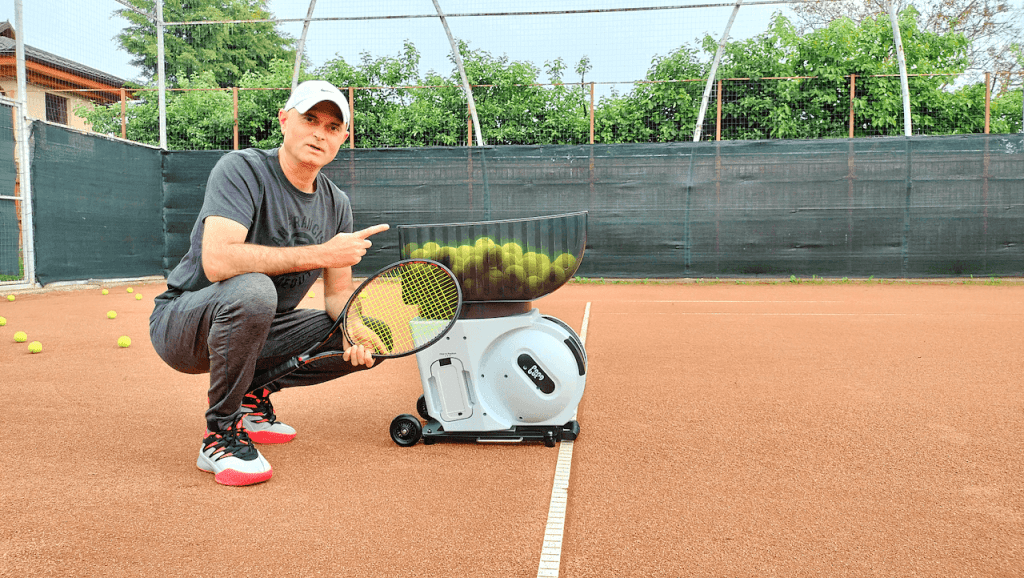
One reason I enjoy using a modern tennis ball machine is the ability to go beyond manual feeding patterns. The machine featured in this session, the Pongbot Pace S Pro, stands out because it is accurate, reliable, and comes loaded with more than 500 pre-programmed drills.
It also includes court movement tracking through built-in sensors, which adds another layer to solo training. But my favorite feature is the custom drill option. Being able to build sequences of up to 45 shots is a huge advantage, especially for coaching or for players who want more realistic combinations.
Instead of feeding one ball over and over, you can create progressions that move from baseline to short ball to volley to overhead. That makes a tennis ball machine feel less like a repetitive tool and more like a training system.
If you want to look at the machine itself, you can find the Pongbot training robot here.
Did We Miss Any Strokes?
That is the fun question. Depending on how specific you want to get, you could break some categories into even more variations. For example, you might separate offensive lobs from defensive lobs, or inside-out forehands from standard crosscourt forehands. But for a practical solo session, these 20 strokes form a strong and well-rounded training menu.
The bigger lesson is this: if your tennis ball machine practice only includes rally balls, you are probably underusing one of the best solo training tools in tennis.
Challenge yourself to build sessions that include spin, height, touch, transition, and finishing. When you do that, the machine becomes much more than a feeder. It becomes a way to rehearse the full language of the game.
F.A.Q.
How many strokes can you practice with a tennis ball machine?
A solid solo session can include 20 different tennis strokes, covering groundstrokes, slices, lobs, drop shots, short ball attacks, half volleys, volleys, drop volleys, and overheads.
What is the best way to organize a tennis ball machine session?
A simple and effective structure is to hit every stroke in two rounds: first crosscourt, then down the line. This builds rhythm first, and then tests control with the more demanding direction.
Can a tennis ball machine help with volleys and overheads?
Yes. A tennis ball machine is very useful for drive volleys, punch volleys, drop volleys, half volleys, and overheads, especially if it allows you to adjust depth, speed, and trajectory.
What features make a tennis ball machine better for advanced practice?
Accuracy, reliable feeding, pre-programmed drills, and custom drill creation are especially valuable. Features like movement tracking can also make solo sessions more purposeful and demanding.
0 Comments